Nakamura 1991 Basalt Sphere Impact Fragmentation Validation
Overview
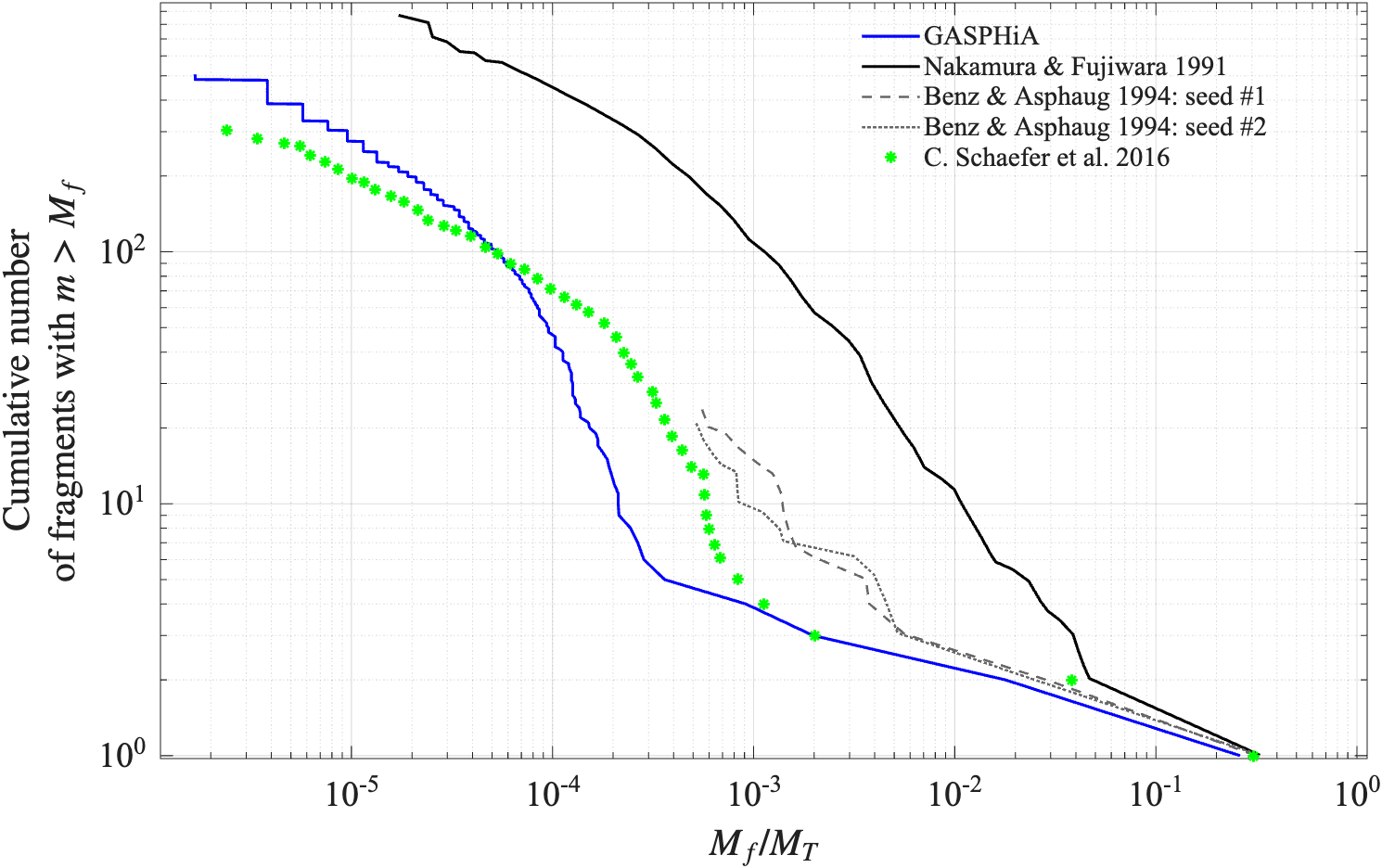
This case reproduces the basalt sphere impact fragmentation experiment of Nakamura & Fujiwara (1991). The core comparison quantity is the cumulative fragment mass distribution:
Given a fragment mass threshold
M_f, how many fragments have mass greater than it?
This type of statistic is sensitive to brittle damage, fracture propagation, fragment identification, and post-processing algorithms, making it suitable as a validation standard for whether the fragmentation chain is usable.
Key data from this run:
- Initial total particle count:
524065 - Particles retained after damage threshold filtering (pre-FoF):
157751 - Total connected fragments identified:
1594 - Effective fragments (particle count > 1):
509 - Maximum fragment mass: ~
0.262of the target sphere mass
Validation Objective
- Damage model
- Particles form reasonable fragment clusters after fracture
- Post-processing algorithm accurately identifies fragments
- Final fragment mass distribution matches experimental or literature trends
Physical Setup and References
This case is based on:
Nakamura & Fujiwara (1991) basalt sphere impact fragmentation experiment
Model setup:
- Target: Basalt sphere
- Projectile: Lucite
- Primary validation quantity: Cumulative fragment mass distribution
Key geometric and physical quantities set in the input script:
- Basalt target sphere radius:
3 cm - Target density:
2700 kg/m^3 - Projectile density:
1180 kg/m^3 - Projectile initial velocity:
3200 m/s
How to Run
Test directory:
| |
The full workflow consists of four steps:
| |
Actual Run Data
Key metrics extracted from this run and post-processing:
| Metric | Value |
|---|---|
| Initial total particle count | 524065 |
| Particles participating in FoF after damage filtering | 157751 |
| Total FoF-identified fragments | 1594 |
| Effective fragments (particle count > 1) | 509 |
| Maximum fragment normalized mass | 2.6208e-01 |
| Minimum fragment normalized mass | 1.6694e-06 |
| Target sphere total mass | 3.0536e-01 kg |
Currently this case uses the von Mises yield model. Interested readers may re-run it with the Lundborg yield model; the difference between the two is approximately 1%.